

The founding of this country articulated principles that were contradictory to the reality that Black people faced. We were told that we held certain unalienable rights while we were actually held as property. We were told that all men are created equal while the law said we were legally denied the human rights that equality required. That contradiction has shaped everything— it shaped how we vote, how we pray, how we understand what government is supposed to do.
Martin Luther King said it plainly. He was not asking America to become something new. He was asking America to be true to what it said on paper. To actually mean the words it had already written down. That is the work our people have been doing for four hundred years. Not revolution. Redemption. Making the country live up to its own promise.
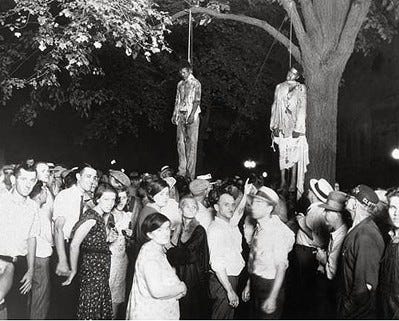
White Americans have not needed the government to protect them from itinerant lynch mobs. White Americans have not needed the government to help them rebuild after an entire community like Greenwood in Tulsa was burned to the ground by a mob that the government would not stop. White Americans have not needed the government to protect them from underfunded segregated schools, or to strike down laws written specifically to keep them out of neighborhoods, or to guarantee them access to a loan.
The voting priorities of white Americans do not necessarily represent moral failure on their part. It is simply the privilege of not being a target easily identified by skin color. Our reason for needing government has been different since the founding of the country than it has been for most white people. We have needed the government to save our lives. White voters across the economic spectrum are generally voting for policies they believe will build and sustain their own prosperity or freedom.
The Black vote has followed the people who would help America become what America said it wanted to be. After the 15th Amendment gave Black men the right to vote, Black voters went to the Republican Party because Republicans were the strongest advocates for the rights of Black people. For a century - for roughly a hundred years - the Black vote was Republican. Then the parties shifted. The people shifted with them. When Democratic candidates and Democratic policies were believed to be the strongest advocates for racial justice and civil rights, Black voters switched their allegiance. We were not voting for the party. We were not voting for the theology of the platform. We were voting for the people who were helping to make America true to its word.
But there is another piece to this answer, and it matters. When a Black voter finds himself or herself voting for a candidate whose platform or positions contradict the voter’s personal moral convictions, this is what’s going on.
Part of that explanation is rooted in a different philosophy about the role of government itself. Many Black voters distinguish between their personal moral and religious beliefs and what they believe government should enforce. A person can hold firm convictions about deeply personal matters while also believing that government should not be the arbiter of those decisions. Government has a role in protecting people from discrimination and violence. Government has a role in ensuring equal access to housing, education, and credit. But government does not belong dictating the intimate choices that belong to individuals and their faith.
This is where the irony cuts sharp. Conservatives claim to believe in limited government— government that stays out of people’s lives. Yet they want government strong enough to enforce their moral beliefs on the most personal questions of life. That is not limited government. That is selective government— powerful when it serves your moral code, weak when it doesn’t. Meanwhile, Black voters who hold personal moral convictions are actually living out a more authentic limited-government philosophy. Black voters are saying: don’t let government dictate these intimate choices, even though we personally believe certain things about them. We are drawing a line between what we believe and what we think government should enforce.
At the same time, Black voters are making choices about which issues rank highest when it comes to what government should do. The data shows that Black Americans are voting for the candidates and policies most likely to address the systemic harms that government has created and perpetuated— harms rooted in slavery, in Jim Crow, in redlining, in the denial of equal protection. We are voting for rescue and protection. We are prioritizing the work of making America live up to what it said it wanted to be.
These two things work together. We hold our beliefs. We also hold a conviction about where government’s authority should and should not reach. And we vote for the people and policies most likely to complete the unfinished work of this country’s founding promise.
This is not an irrational preoccupation with race. It is a clear-eyed understanding of the Black experience in America. Our history is not taught in full in most schools, so those who understand this perspective usually learned it through family, church, and tradition, from the grandmothers and elders who carried the story and handed it down.
That is where the sorting begins. Not with some abstract ranking of moral issues alone. With the lived reality that our people have needed government to undo what government did to us, and with the conviction that government should protect us from harm without dictating our most intimate choices.
Amen. Truly. 🗣️