

Somebody asked me a question recently. “Did you ever not feel like preaching on a Sunday morning?”
My mind went straight to the Sundays when I was exhausted. My body was tired. My mind was tired. My soul seemed tired too. But here is the irony. On those Sundays, when I was fully conscious that I did not have what it took to deliver a meaningful sermon, I depended on the power of God more than I ever did when I felt strong. That is true for preachers and parishioners alike. We seem to let God empower us only after we realize we do not have enough power of our own. Those were the most impactful sermons I ever preached. Those were the Sundays that gave meaning to the old expression, let go and let God. We cannot do anything worth doing without God’s power, and it usually takes a Sunday like that to remind us.
But physical weariness was never the hardest part.
The hardest Sundays were the ones when I had to preach after being attacked by evil inside the congregation.
Some preachers respond to church conflict by fussing in the pulpit. I always asked God to give me the strength not to do that. Part of it was that most member meanness had nothing to do with me. It was wise not to take it personally. People lash out at pastors because of what is happening to them at home, at work or at school. So I disciplined myself to pray for the people who seemed to hate me in a particular season.
The other part was simple arithmetic. It made no sense to fuss at an entire congregation when only a small percentage of the people knew anything about the matter. Leaders would be surprised how preoccupied most folks are with their own struggles. They do not have time to invest in the interpersonal or organizational business that consumes us. When somebody told me that “everybody” was upset about something, I would ask them how many people were in their everybody. The number usually got small in a hurry. Too often, addressing an issue from the pulpit only informs the people who are hearing about it for the first time.
So the contentious matters never kept me out of the pulpit. If anything, a member in the hospital captured my attention and focus more than a member who was angry with me. Sickness moved me to pray. Meanness I learned to set down before Sunday morning.
What gave me pause was preaching on the Sunday after a nasty, personal attack that carried implications for my reputation in the church, in the community and in my own family.
I served in public office, so I expected false attacks that were politically motivated. Church was supposed to be different. I was accused of being a liar by a deacon in a deacon meeting. I was accused of inappropriate behavior by a trustee who also threatened to inform the media. I was accused of stealing intellectual property from a leading member of the church. All of those accusations were brought to the leading officers of the church. One of them required me to hire legal counsel. And each one brought me a kind of stress I cannot describe.
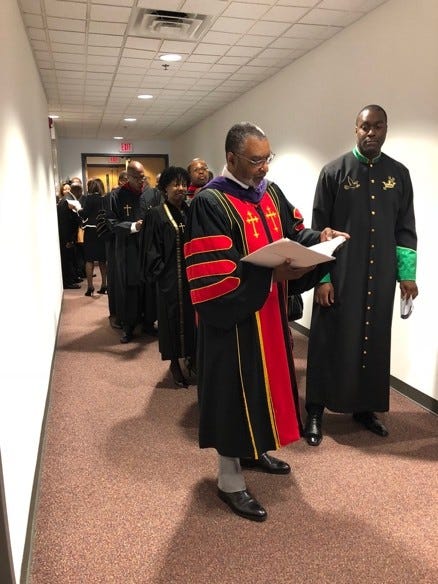
So many scandals come out of churches now that clergy are assumed guilty even when they are proven innocent. My fear was that if any of those accusations became public, folks would assume I used my influence to escape conviction. An accusation travels faster than the truth. When you are a high profile leader, a rumor can damage your image, your position and your legacy.
So I had to stand in the pulpit, focus on God and my assignment, and preach with passion and power while looking into the faces of my accusers and their little entourages who believed what they believed. Some Sundays that seemed like too much for God to expect of me.
I have talked to enough pastors to know that my experience was not unusual. Most of us have preached on a Sunday morning while carrying something we could not tell anybody in the room.
But the same power that gave me strength when I was physically tired gave me the ability to preach past the accusers. Those other people did not come to church to hear about my trouble. They came for help with theirs.
And I thank God for the grace that kept me from smacking somebody, or beating them with the stick I carry in my car.